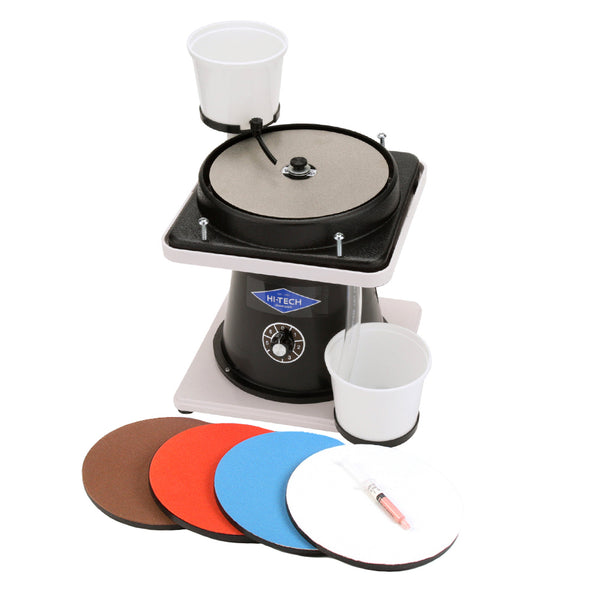
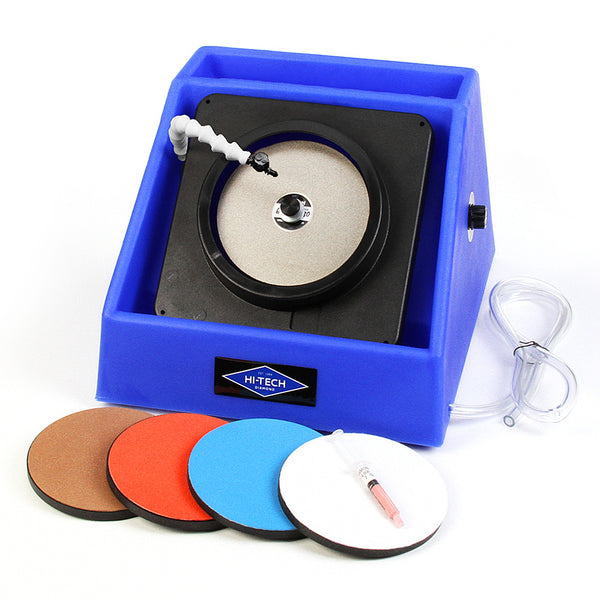
You want compact, flexible equipment.
A single disc handles flat backs, specimen faces, free-form shapes, and cabochons. You trade a smaller footprint and lower listed entry price for changing discs between grit stages.
Compare flat laps →Lapidary decision guide
Both can shape and polish stone. The important difference is how you move through the work: changing discs on one lap, or moving a stone across a row of installed wheels.
Quick answer
A single disc handles flat backs, specimen faces, free-form shapes, and cabochons. You trade a smaller footprint and lower listed entry price for changing discs between grit stages.
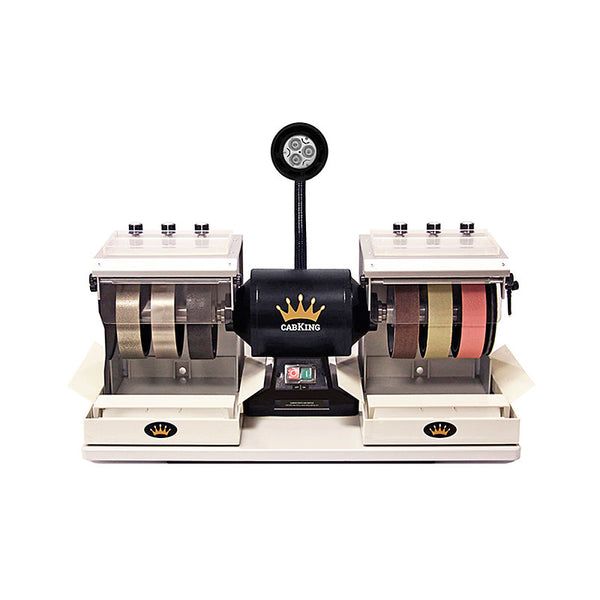
Compare flat laps →Multiple wheels stay installed in sequence, so you can move from shaping to polishing without stopping to exchange the main abrasive surface at every stage.
Compare cabbing machines →A slant cabber is still a flat-lap machine. The angled face improves visibility and supports seated work while preserving the compact, interchangeable-disc approach.
Compare cabbing machines →Side by side
| Decision | Flat or slant lap | Multi-wheel cabbing machine |
|---|---|---|
| Working surface | One horizontal or angled disc at a time | Several wheels installed in a grit sequence |
| Moving through grits | Change discs or backing plates between stages | Move the stone from wheel to wheel |
| Natural strength | Flat backs, specimen faces, free-form shapes, and occasional cabochons | Repeated shaping and polishing of rounded cabochons |
| Current listed entry example | $599 · Hi-Tech Diamond All-U-Need 6 | $1,499 · CabKing 6 |
| Example size | 10 × 10 × 12 in · 9 lb | 27 × 13.5 × 12 in · 62 lb |
| Speed control in these examples | Variable · 800–3,400 rpm | Single speed · 1,800 rpm |
Before you buy
Official-source examples
How this guide was built
The examples use current manufacturer pages and the same documented machine records as the finder. Lapidary Finder has no affiliate links or paid placement on this page. Suitability statements explain workflow tradeoffs; they are not a substitute for hands-on instruction or the manufacturer's safety guidance.